


Qt Quick Particles Examples - Emitters▲
This is a collection of small QML examples relating to using Emitters in the particle system. Each example is a small QML file emphasizing a particular type or feature.
Velocity from motion gives the effect of strong particle motion through primarily moving the emitters:
Emitter {
    id: trailsNormal
    system: sys1

    emitRate: 500
    lifeSpan: 2000

    y: mouseArea.pressed ? mouseArea.mouseY : circle.cy
    x: mouseArea.pressed ? mouseArea.mouseX : circle.cx

    velocity: PointDirection {xVariation: 4; yVariation: 4;}
    acceleration: PointDirection {xVariation: 10; yVariation: 10;}
    velocityFromMovement: 8

    size: 8
    sizeVariation: 4
}
Burst and pulse calls the burst and pulse methods on two idential emitters.
    if (lastWasPulse) {
        burstEmitter.burst(500);
        lastWasPulse = false;
    } else {
        pulseEmitter.pulse(500);
        lastWasPulse = true;
    }
Note how burst takes an argument of number of particles to emit, and pulse takes an argument of number of milliseconds to emit for. This gives a slightly different behaviour, which is easy to see in this example.
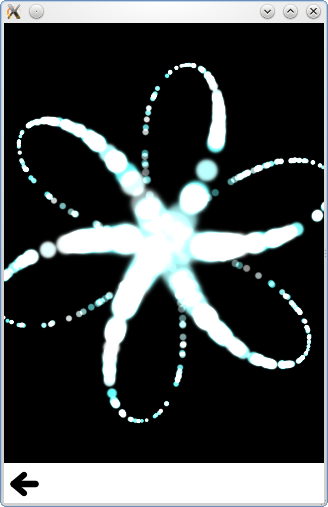
Custom Emitter connects to the emitParticles signal to set arbitrary values on particle data as they're emitted;
onEmitParticles: {
    for (var i=0; i<particles.length; i++) {
        var particle = particles[i];
        particle.startSize = Math.max(02,Math.min(492,Math.tan(particle.t/2)*24));
        var theta = Math.floor(Math.random() * 6.0);
        particle.red = theta == 0 || theta == 1 || theta == 2 ? 0.2 : 1;
        particle.green = theta == 2 || theta == 3 || theta == 4 ? 0.2 : 1;
        particle.blue = theta == 4 || theta == 5 || theta == 0 ? 0.2 : 1;
        theta /= 6.0;
        theta *= 2.0*Math.PI;
        theta += sys.convert(sys.petalRotation);//Convert from degrees to radians
        particle.initialVX = petalLength * Math.cos(theta);
        particle.initialVY = petalLength * Math.sin(theta);
        particle.initialAX = particle.initialVX * -0.5;
        particle.initialAY = particle.initialVY * -0.5;
    }
}
This is used to emit curving particles in six rotating spokes.
Emit mask sets an image mask on the Emitter, to emit out of an arbitrary shape.
shape: MaskShape {
    source: "../../images/starfish_mask.png"
}
Maximum emitted emits no more than a certain number of particles at a time. This example makes it easy to see what happens when the limit is reached.
Shape and Direction emits particles out of an unfilled Ellipse shape, using a https://
shape: EllipseShape {fill: false}
velocity: TargetDirection {
    targetX: root.width/2
    targetY: root.height/2
    proportionalMagnitude: true
    magnitude: 0.5
}
This sends the particles towards the center of the ellipse with proportional speed, keeping the ellipse outline as they move to the center.
https:// uses that type to add smoke particles to trail the fire particles in the scene.
onEmitParticles: {
    for (var i=0; i<particles.length; i++) {
        var particle = particles[i];
        particle.startSize = Math.max(02,Math.min(492,Math.tan(particle.t/2)*24));
        var theta = Math.floor(Math.random() * 6.0);
        particle.red = theta == 0 || theta == 1 || theta == 2 ? 0.2 : 1;
        particle.green = theta == 2 || theta == 3 || theta == 4 ? 0.2 : 1;
        particle.blue = theta == 4 || theta == 5 || theta == 0 ? 0.2 : 1;
        theta /= 6.0;
        theta *= 2.0*Math.PI;
        theta += sys.convert(sys.petalRotation);//Convert from degrees to radians
        particle.initialVX = petalLength * Math.cos(theta);
        particle.initialVY = petalLength * Math.sin(theta);
        particle.initialAX = particle.initialVX * -0.5;
        particle.initialAY = particle.initialVY * -0.5;
    }
}
List of Files▲
Files:
List of Files▲
-
particles/emitters/content/burstandpulse.qml
-
particles/emitters/content/customemitter.qml
-
particles/emitters/content/emitmask.qml
-
particles/emitters/content/maximumemitted.qml
-
particles/emitters/content/shapeanddirection.qml
-
particles/emitters/content/trailemitter.qml
-
particles/emitters/content/velocityfrommotion.qml
-
particles/emitters/emitters.pro
-
particles/emitters/emitters.qml
-
particles/emitters/emitters.qmlproject
-
particles/emitters/emitters.qrc
-
particles/emitters/main.cpp