


Drop Site Example▲
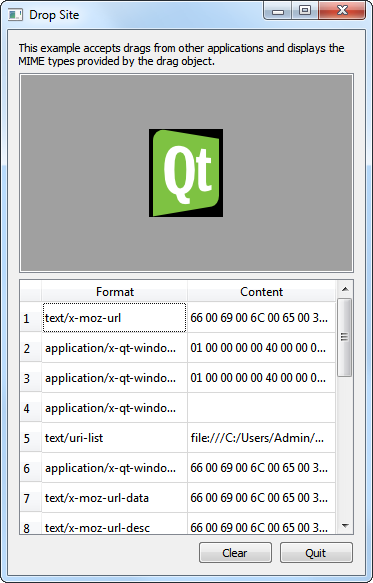
The Drop Site example accepts drops from other applications, and displays the MIME formats provided by the drag object.
There are two classes, DropArea and DropSiteWindow, and a main() function in this example. A DropArea object is instantiated in DropSiteWindow; a DropSiteWindow object is then invoked in the main() function.
DropArea Class Definition▲
The DropArea class is a subclass of https:// with a public slot, clear(), and a changed() signal.
class DropArea : public QLabel
{
    Q_OBJECT

public:
    explicit DropArea(QWidget *parent = nullptr);

public slots:
    void clear();

signals:
    void changed(const QMimeData *mimeData = nullptr);
In addition, DropArea also contains a private instance of https:// and reimplementations of four https:// event handlers:
-
https://()
-
https://()
-
https://()
-
https://()
These event handlers are further explained in the implementation of the DropArea class.
protected:
    void dragEnterEvent(QDragEnterEvent *event) override;
    void dragMoveEvent(QDragMoveEvent *event) override;
    void dragLeaveEvent(QDragLeaveEvent *event) override;
    void dropEvent(QDropEvent *event) override;

private:
    QLabel *label;
};
DropArea Class Implementation▲
In the DropArea constructor, we set the https:// to 200x200 pixels, the https:// to both https:// and https://, and we align its contents to the center.
DropArea::DropArea(QWidget *parent)
    : QLabel(parent)
{
    setMinimumSize(200, 200);
    setFrameStyle(QFrame::Sunken | QFrame::StyledPanel);
    setAlignment(Qt::AlignCenter);
    setAcceptDrops(true);
    setAutoFillBackground(true);
    clear();
}
Also, we enable drop events in DropArea by setting the https:// property to true. Then, we enable the https:// property and invoke the clear() function.
The https://() event handler is called when a drag is in progress and the mouse enters the DropArea object. For the DropSite example, when the mouse enters DropArea, we set its text to "<drop content>" and highlight its background.
void DropArea::dragEnterEvent(QDragEnterEvent *event)
{
    setText(tr("<drop content>"));
    setBackgroundRole(QPalette::Highlight);

    event->acceptProposedAction();
    emit changed(event->mimeData());
}
Then, we invoke https://() on event, setting the drop action to the one proposed. Lastly, we emit the changed() signal, with the data that was dropped and its MIME type information as a parameter.
For https://(), we just accept the proposed https:// object, event, with https://().
void DropArea::dragMoveEvent(QDragMoveEvent *event)
{
    event->acceptProposedAction();
}
The DropArea class's implementation of https://() extracts the event's mime data and displays it accordingly.
void DropArea::dropEvent(QDropEvent *event)
{
    const QMimeData *mimeData = event->mimeData();
The mimeData object can contain one of the following objects: an image, HTML text, plain text, or a list of URLs.
    if (mimeData->hasImage()) {
        setPixmap(qvariant_cast<QPixmap>(mimeData->imageData()));
    } else if (mimeData->hasHtml()) {
        setText(mimeData->html());
        setTextFormat(Qt::RichText);
    } else if (mimeData->hasText()) {
        setText(mimeData->text());
        setTextFormat(Qt::PlainText);
    } else if (mimeData->hasUrls()) {
        QList<QUrl> urlList = mimeData->urls();
        QString text;
        for (int i = 0; i < urlList.size() && i < 32; ++i)
            text += urlList.at(i).path() + QLatin1Char('\n');
        setText(text);
    } else {
        setText(tr("Cannot display data"));
}-
If mimeData contains an image, we display it in DropArea with https://().
-
If mimeData contains HTML, we display it with https://() and set DropArea's text format as https://.
-
If mimeData contains plain text, we display it with https://() and set DropArea's text format as https://. In the event that mimeData contains URLs, we iterate through the list of URLs to display them on individual lines.
-
If mimeData contains other types of objects, we set DropArea's text, with https://() to "Cannot display data" to inform the user.
We then set DropArea's https:// to https:// and we accept event's proposed action.
    setBackgroundRole(QPalette::Dark);
    event->acceptProposedAction();
}
The https://() event handler is called when a drag is in progress and the mouse leaves the widget.
void DropArea::dragLeaveEvent(QDragLeaveEvent *event)
{
    clear();
    event->accept();
}
For DropArea's implementation, we clear invoke clear() and then accept the proposed event.
The clear() function sets the text in DropArea to "<drop content>" and sets the https:// to https://. Lastly, it emits the changed() signal.
void DropArea::clear()
{
    setText(tr("<drop content>"));
    setBackgroundRole(QPalette::Dark);

    emit changed();
}
DropSiteWindow Class Definition▲
The DropSiteWindow class contains a constructor and a public slot, updateFormatsTable().
class DropSiteWindow : public QWidget
{
    Q_OBJECT

public:
    DropSiteWindow();

public slots:
    void updateFormatsTable(const QMimeData *mimeData);

private:
    DropArea *dropArea;
    QLabel *abstractLabel;
    QTableWidget *formatsTable;

    QPushButton *clearButton;
    QPushButton *quitButton;
    QDialogButtonBox *buttonBox;
};
The class also contains a private instance of DropArea, dropArea, https://, abstractLabel, https://, formatsTable, https://, buttonBox, and two https:// objects, clearButton and quitButton.
DropSiteWindow Class Implementation▲
In the constructor of DropSiteWindow, we instantiate abstractLabel and set its https:// property to true. We also call the https://() function to adjust abstractLabel's size according to its contents.
DropSiteWindow::DropSiteWindow()
{
    abstractLabel = new QLabel(tr("This example accepts drags from other "
                                  "applications and displays the MIME types "
                                  "provided by the drag object."));
    abstractLabel->setWordWrap(true);
    abstractLabel->adjustSize();
Then we instantiate dropArea and connect its changed() signal to DropSiteWindow's updateFormatsTable() slot.
    dropArea = new DropArea;
    connect(dropArea, &DropArea::changed,
            this, &DropSiteWindow::updateFormatsTable);
We now set up the https:// object, formatsTable. Its horizontal header is set using a https:// object, labels. The number of columms are set to two and the table is not editable. Also, the formatTable's horizontal header is formatted to ensure that its second column stretches to occupy additional space available.
    QStringList labels;
    labels << tr("Format") << tr("Content");

    formatsTable = new QTableWidget;
    formatsTable->setColumnCount(2);
    formatsTable->setEditTriggers(QAbstractItemView::NoEditTriggers);
    formatsTable->setHorizontalHeaderLabels(labels);
    formatsTable->horizontalHeader()->setStretchLastSection(true);
Two https:// objects, clearButton and quitButton, are instantiated and added to buttonBox - a https:// object. We use https:// here to ensure that the push buttons are presented in a layout that conforms to the platform's style.
    clearButton = new QPushButton(tr("Clear"));
    quitButton = new QPushButton(tr("Quit"));

    buttonBox = new QDialogButtonBox;
    buttonBox->addButton(clearButton, QDialogButtonBox::ActionRole);
    buttonBox->addButton(quitButton, QDialogButtonBox::RejectRole);

    connect(quitButton, &QAbstractButton::clicked, this, &QWidget::close);
    connect(clearButton, &QAbstractButton::clicked, dropArea, &DropArea::clear);
The https://() signals for quitButton and clearButton are connected to https://() and clear(), respectively.
For the layout, we use a https://, mainLayout, to arrange our widgets vertically. We also set the window title to "Drop Site" and the minimum size to 350x500 pixels.
    QVBoxLayout *mainLayout = new QVBoxLayout(this);
    mainLayout->addWidget(abstractLabel);
    mainLayout->addWidget(dropArea);
    mainLayout->addWidget(formatsTable);
    mainLayout->addWidget(buttonBox);

    setWindowTitle(tr("Drop Site"));
    setMinimumSize(350, 500);
}
We move on to the updateFormatsTable() function. This function updates the formatsTable, displaying the MIME formats of the object dropped onto the DropArea object. First, we set https://'s https:// property to 0. Then, we validate to ensure that the https:// object passed in is a valid object.
void DropSiteWindow::updateFormatsTable(const QMimeData *mimeData)
{
    formatsTable->setRowCount(0);
    if (!mimeData)
        return;
Once we are sure that mimeData is valid, we iterate through its supported formats using the https://. This keyword has the following format:
foreach(variable, container)In our example, format is the variable and the container is a https://, obtained from mimeData->formats().
The https://() function returns a https:// object, containing all the formats supported by the mimeData.
    for (const QString &format : mimeData->formats()) {
        QTableWidgetItem *formatItem = new QTableWidgetItem(format);
        formatItem->setFlags(Qt::ItemIsEnabled);
        formatItem->setTextAlignment(Qt::AlignTop | Qt::AlignLeft);
Within each iteration, we create a https://, formatItem and we set its https:// to https://, and its https:// to https:// and https://.
A https:// object, text, is customized to display data according to the contents of format. We invoke https://'s https://() function on text, to obtain a string that has no additional space before, after or in between words.
        QString text;
        if (format == QLatin1String("text/plain")) {
            text = mimeData->text().simplified();
        } else if (format == QLatin1String("text/html")) {
            text = mimeData->html().simplified();
        } else if (format == QLatin1String("text/uri-list")) {
            QList<QUrl> urlList = mimeData->urls();
            for (int i = 0; i < urlList.size() && i < 32; ++i)
                text.append(urlList.at(i).toString() + QLatin1Char(' '));
        } else {
            QByteArray data = mimeData->data(format);
            for (int i = 0; i < data.size() && i < 32; ++i)
                text.append(QStringLiteral("%1 ").arg(uchar(data[i]), 2, 16, QLatin1Char('0')).toUpper());
        }
If format contains a list of URLs, we iterate through them, using spaces to separate them. On the other hand, if format contains an image, we display the data by converting the text to hexadecimal.
        int row = formatsTable->rowCount();
        formatsTable->insertRow(row);
        formatsTable->setItem(row, 0, new QTableWidgetItem(format));
        formatsTable->setItem(row, 1, new QTableWidgetItem(text));
    }

    formatsTable->resizeColumnToContents(0);
}
Once text has been customized to contain the appropriate data, we insert both format and text into formatsTable with https://(). Lastly, we invoke https://() on formatsTable's first column.
The main() Function▲
Within the main() function, we instantiate DropSiteWindow and invoke its https://() function.
int main(int argc, char *argv[])
{
    QApplication app(argc, argv);
    DropSiteWindow window;
    window.show();
    return app.exec();
}
List of Files▲
Files:
List of Files▲
-
draganddrop/dropsite/droparea.cpp
-
draganddrop/dropsite/droparea.h
-
draganddrop/dropsite/dropsite.pro
-
draganddrop/dropsite/dropsitewindow.cpp
-
draganddrop/dropsite/dropsitewindow.h
-
draganddrop/dropsite/main.cpp