


Graphics▲
Cross-platform applications can use Qt to display graphical elements. Qt abstracts the platforms' underlying graphics APIs so that developers can focus on the application code.

The Qt Rendering Hardware Interface (RHI) translates 3D graphics call from Qt applications to the available graphics APIs on the target platform.
The supported graphics APIs are:
-
OpenGL (version 3 and higher)
-
OpenGL ES (version 2 and higher)
-
Vulkan (1.0 and higher)
-
Direct3D 11 (11.1 and higher)
-
Metal
Graphics in Qt Quick▲
Qt Quick applications use a https:// for rendering. The scene graph renderer can create efficient graphics calls and increase performance. The scene graph is has an accessible API which gives you the flexibility to create complex but fast graphics.
The pages in the following list contain more information about rendering Qt Quick applications.
-
https://
-
https://
-
https://
-
https:// - How to integrate application-provided graphics commands (OpenGL, Vulkan, Direct3D, etc.) into a Qt Quick scene graph.
Qt Quick can also be rendered using http://. This raster paint engine enables rendering Qt Quick applications on platforms that do not have OpenGL.
Choosing a Rendering Path▲
Qt uses the target platform's graphics APIs whenever possible, however, it is possible to set up Qt's rendering path with a specific API. In many cases, choosing a specific API can increase performance and allows the developers to deploy on a platform that have a specific graphics API. Visit the https:// page on how to set the render path in https://.
3D Graphics with Qt Quick 3D▲
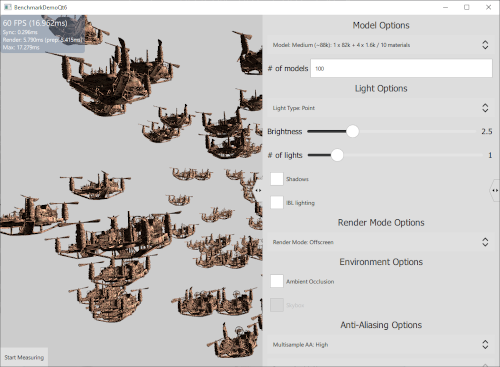
Qt Quick 3D is an add-on that provides a high-level API for creating 3D content and 3D user interfaces based on Qt Quick. It extends the https:// which lets you implement 3D content on 2D Qt Quick applications.
Shader Effects▲
The https:// provides a tool, https://, to translate vertex and fragment shaders into a package for Qt Quick interfaces. In particular, the https:// QML type and https:// subclasses can use the output of QSB. Qt Quick 3D has its own framework for importing shaders into 3D scenes.
The following list contains information about shader effects.
-
https://
-
Programmable Materials, Effects, Geometry, and Texture data - materials and shaders in Qt Quick 3D
High-Level Graphics with Qt GUI▲
https:// provides a high level windowing, painting, and typography system. https:// provides an API for drawing vector graphics, text and images onto different surfaces, or https:// instances, such as https://, https://, https://, and https://. For Qt Widgets user interfaces, Qt uses a software renderer.
The following list contains information about Qt GUIs high-level drawing APIs.
-
https://
-
https://
-
https://
Qt OpenGL Module▲
The https:// module is for applications that require OpenGL access. This module is to maintain compatibility with Qt 5 applications and with Qt GUI. For user interfaces that use https://, https:// is a widget that can add OpenGL scenes.
Printing▲
Qt supports printing both directly to actual printers, locally or on the network, as well as producing PDF output. How to do printing with Qt is described in detail on the https:// page.
Images▲
Qt supports convenient reading, writing, and manipulating of images through the https:// class. In addition, for more fine grained control of how images are loaded or saved, you can use the https:// and https:// classes respectively. To add support for additional image formats, outside of the ones provided by Qt, you can create image format plugins by using https:// and https://.
See the https:// page for more information.