


QRadialGradient Class▲
-
Header: QRadialGradient
-
CMake:
find_package(Qt6 REQUIRED COMPONENTS Gui)
target_link_libraries(mytarget PRIVATE Qt6::Gui)
-
qmake: QT += gui
-
Inherits: https://
-
Group: QRadialGradient is part of https://
Detailed Description▲
Qt supports both simple and extended radial gradients.
Simple radial gradients interpolate colors between a focal point and end points on a circle surrounding it. Extended radial gradients interpolate colors between a focal circle and a center circle. Points outside the cone defined by the two circles will be transparent. For simple radial gradients the focal point is adjusted to lie inside the center circle, whereas the focal point can have any position in an extended radial gradient.
Outside the end points the gradient is either padded, reflected or repeated depending on the currently set https:// method:
|
|
|
|
|
https:// (default) |
https:// |
https:// |
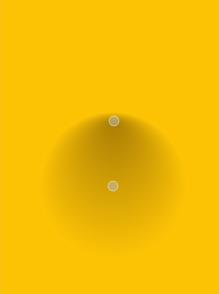
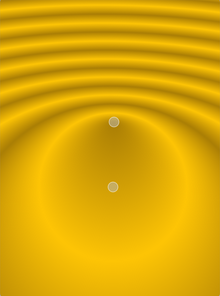
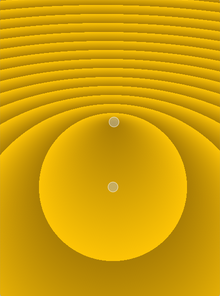
The colors in a gradient is defined using stop points of the https:// type, i.e. a position and a color. Use the https://() or the https://() function to define the stop points. It is the gradient's complete set of stop points that describes how the gradient area should be filled. If no stop points have been specified, a gradient of black at 0 to white at 1 is used.
In addition to the functions inherited from https://, the https:// class provides the https://(), https://() and https://() functions returning the gradient's center, focal point and radius respectively.
See Also▲
See also https://, https://, The Gradients Example
Member Function Documentation▲
QRadialGradient::QRadialGradient()▲
Constructs a simple radial gradient with the center and focal point at (0, 0) with a radius of 1.
QRadialGradient::QRadialGradient(const QPointF ¢er, qreal radius, const QPointF &focalPoint)▲
Constructs a simple radial gradient with the given center, radius and focalPoint.
If the given focal point is outside the circle defined by the center point and radius, it will be re-adjusted to lie at a point on the circle where it intersects with the line from center to focalPoint.
See Also▲
See also https://(), https://()
QRadialGradient::QRadialGradient(qreal cx, qreal cy, qreal radius, qreal fx, qreal fy)▲
Constructs a simple radial gradient with the given center (cx, cy), radius and focal point (fx, fy).
If the given focal point is outside the circle defined by the center (cx, cy) and the radius it will be re-adjusted to the intersection between the line from the center to the focal point and the circle.
See Also▲
See also https://(), https://()
QRadialGradient::QRadialGradient(const QPointF ¢er, qreal radius)▲
Constructs a simple radial gradient with the given center, radius and the focal point in the circle center.
See Also▲
See also https://(), https://()
QRadialGradient::QRadialGradient(qreal cx, qreal cy, qreal radius)▲
Constructs a simple radial gradient with the center at (cx, cy) and the specified radius. The focal point lies at the center of the circle.
See Also▲
See also https://(), https://()
QRadialGradient::QRadialGradient(const QPointF ¢er, qreal centerRadius, const QPointF &focalPoint, qreal focalRadius)▲
Constructs an extended radial gradient with the given center, centerRadius, focalPoint, and focalRadius.
QRadialGradient::QRadialGradient(qreal cx, qreal cy, qreal centerRadius, qreal fx, qreal fy, qreal focalRadius)▲
Constructs an extended radial gradient with the given center (cx, cy), center radius, centerRadius, focal point, (fx, fy), and focal radius focalRadius.
QPointF QRadialGradient::center() const▲
Returns the center of this radial gradient in logical coordinates.
See Also▲
See also https://(), https://()
qreal QRadialGradient::centerRadius() const▲
Returns the center radius of this radial gradient in logical coordinates.
See Also▲
See also https://(), https://()
QPointF QRadialGradient::focalPoint() const▲
Returns the focal point of this radial gradient in logical coordinates.
See Also▲
See also https://(), https://()
qreal QRadialGradient::focalRadius() const▲
Returns the focal radius of this radial gradient in logical coordinates.
See Also▲
See also https://(), https://()
qreal QRadialGradient::radius() const▲
Returns the radius of this radial gradient in logical coordinates.
Equivalent to https://()
See Also▲
See also https://(), https://()
void QRadialGradient::setCenter(const QPointF ¢er)▲
Sets the center of this radial gradient in logical coordinates to center.
See Also▲
See also https://()
void QRadialGradient::setCenter(qreal x, qreal y)▲
This is an overloaded function.
Sets the center of this radial gradient in logical coordinates to (x, y).
See Also▲
See also https://()
void QRadialGradient::setCenterRadius(qreal radius)▲
Sets the center radius of this radial gradient in logical coordinates to radius
See Also▲
See also https://()
void QRadialGradient::setFocalPoint(const QPointF &focalPoint)▲
Sets the focal point of this radial gradient in logical coordinates to focalPoint.
See Also▲
See also https://()
void QRadialGradient::setFocalPoint(qreal x, qreal y)▲
This is an overloaded function.
Sets the focal point of this radial gradient in logical coordinates to (x, y).
See Also▲
See also https://()
void QRadialGradient::setFocalRadius(qreal radius)▲
Sets the focal radius of this radial gradient in logical coordinates to radius
See Also▲
See also https://()
void QRadialGradient::setRadius(qreal radius)▲
Sets the radius of this radial gradient in logical coordinates to radius
Equivalent to https://()
See Also▲
See also https://()